PC GAMING MICE
Best PC Gaming Mice for Every Grip Style (2026)
UPDATED 2026 // 12 MIN READ // 09 PRODUCTS
Mouse specifications are the most misleading in the whole peripheral market. DPI numbers have been in an arms race for a decade and are now quoted at figures nobody uses. Polling rates are marketed in increments most hands cannot exploit. Meanwhile the two things that actually change how you play — the weight and the shape — get a single line on the box.
The order that matters is shape against your hand and grip, then weight, then buttons, then sensor. Every mouse on this list has a sensor that is far beyond what a human can out-track. None of them will lose you a fight because of the sensor. The one that fits your hand badly will.
The nine below span 54 grams to weighted-and-heavy, symmetrical to aggressively ergonomic, two side buttons to nineteen. Each entry states what grip and what genre it suits, because that is the decision, and a diagram further down shows where each grip actually contacts the mouse.
At a glance
09 ROWS // SCROLL HORIZONTALLY ON MOBILE
| Product | Best For | Key Spec | Trade-off | Link |
|---|---|---|---|---|
| 01Logitech G PRO X Superlight 2 Wireless | Claw and fingertip players in shooters, and anyone who has decided their… | 60G · WIRELESS · 44K DPI | Few side buttons — anyone who binds a lot of abilities will find it sparse | AMAZON |
| 02Razer Viper V3 Pro Wireless Esports Mouse | Competitive shooter players at low sensitivity who make large arm movements… | 54G · WIRELESS · 35K DPI | Stripped-down feature set — two side buttons and nothing else | AMAZON |
| 03Logitech G305 Lightspeed Wireless Mouse | Anyone who wants reliable wireless without managing another charging cable,… | WIRELESS · LIGHTSPEED · AA BATTERY | The AA adds weight compared with the lithium-cell mice above it on this list | AMAZON |
| 04Razer Basilisk V3 Wired Ergonomic Mouse | Palm-grip users, MMO and strategy players, and anyone who spends as much time… | WIRED · 26K DPI · HYPERSCROLL · ERGONOMIC | Heavier than any of the lightweight options above — this is not a flick-aiming mouse | AMAZON |
| 05Logitech G502 HERO Wired Gaming Mouse | Players who prefer a deliberate, weighted feel and want a lot of thumb… | WIRED · 25,600 DPI · ADJUSTABLE WEIGHTS | Heavy even with every weight removed — the frame itself is substantial | AMAZON |
| 06Razer Naga V2 HyperSpeed Wireless MMO Mouse | MMO, ARPG, and strategy players, plus anyone driving editing software with a… | WIRELESS · 19 BUTTONS · MMO | The learning curve on a thumb grid is real — expect a week of pressing the wrong number | AMAZON |
| 07Logitech G PRO X2 SUPERSTRIKE Wireless Mouse | Players who have had double-click failures before, and anyone who wants to… | WIRELESS · MAGNETIC ANALOG SWITCHES | A newer switch technology with a shorter track record than the mechanical switches it replaces | AMAZON |
| 08Redragon M612 Wired RGB Gaming Mouse | A first gaming mouse, a second machine, or a spare that lives in a bag | WIRED · 8000 DPI · RGB | Build quality and switch feel are a clear step below the established brands | AMAZON |
| 09Logitech G305 Lightspeed Wireless (White) | The white-and-wood desk aesthetic — anyone building a light-themed setup who… | WIRELESS · 99G · AA BATTERY · 12K DPI | White plastic shows finger grime sooner and needs an occasional wipe-down to stay looking clean | AMAZON |
The picks

Logitech G PRO X Superlight 2 Wireless
Sixty grams, wireless, and a symmetrical shape that suits claw and fingertip grips. The reference point that most other lightweight mice get compared against.
TRADE-OFFS
- Few side buttons — anyone who binds a lot of abilities will find it sparse
- A symmetrical body with no thumb rest gives palm-grip users less to hold onto
- A wireless mouse is one more thing on the desk that needs charging

Razer Viper V3 Pro Wireless Esports Mouse
The lightest mouse on this list at 54 grams. A tournament-oriented shape with almost nothing left on it that is not load-bearing.
TRADE-OFFS
- Stripped-down feature set — two side buttons and nothing else
- A very light mouse amplifies hand tremor and unsteadiness rather than damping it
- The flat profile does not fill a large hand in a palm grip

Logitech G305 Lightspeed Wireless Mouse
The wireless mouse that made wireless normal. Runs on a single AA, which means it never needs charging downtime — you swap a cell and keep going.
TRADE-OFFS
- The AA adds weight compared with the lithium-cell mice above it on this list
- No RGB and no on-board frills, which some people will miss
- The shape is on the small side for large hands using a palm grip

Razer Basilisk V3 Wired Ergonomic Mouse
A right-handed ergonomic shape with a HyperScroll wheel that switches between ratcheted and free-spinning. The free-spin mode is the feature people keep after trying it.
TRADE-OFFS
- Heavier than any of the lightweight options above — this is not a flick-aiming mouse
- Right-handed shape only
- A cable adds drag that a wireless mouse does not have, however good the cable is
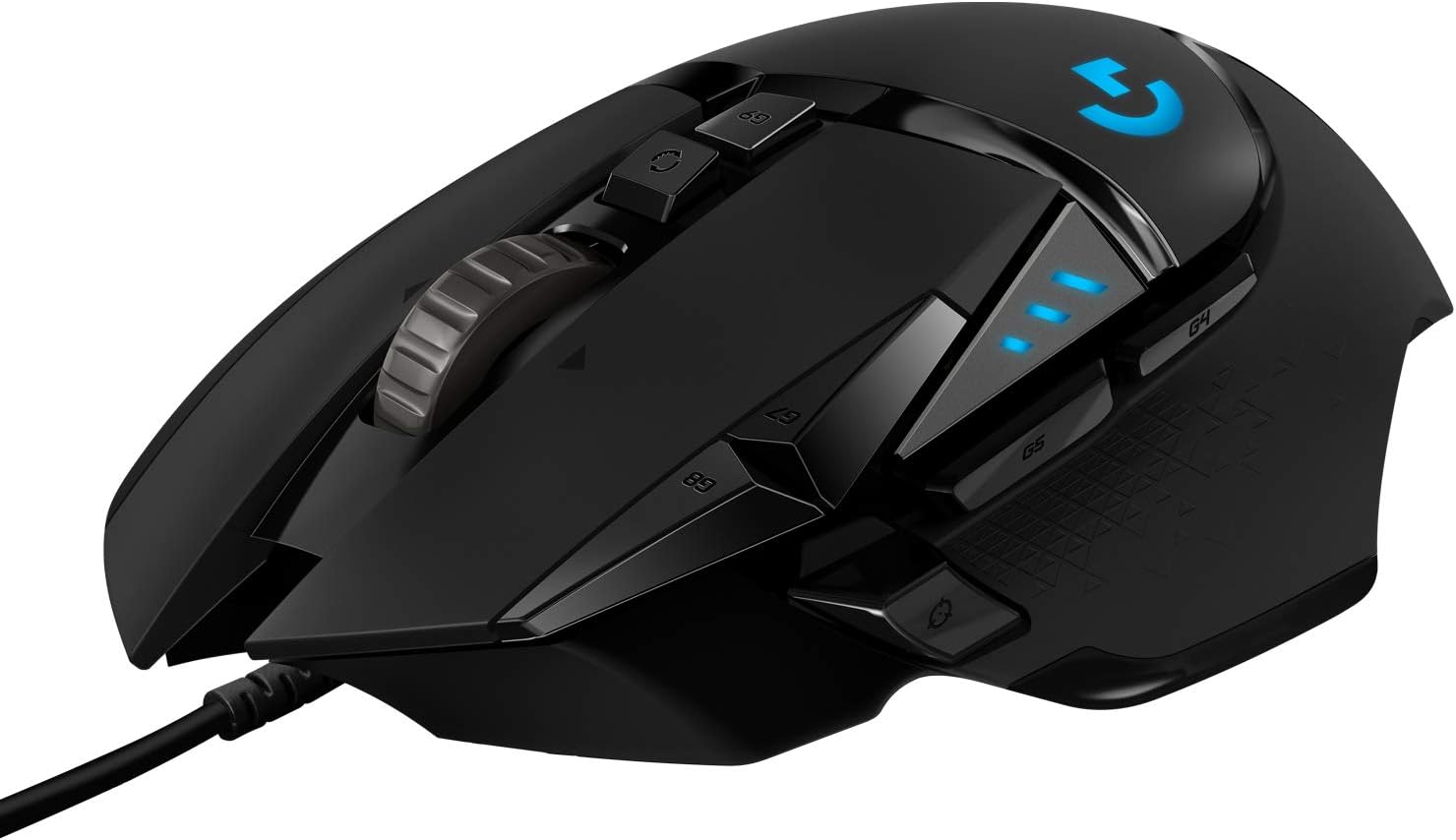
Logitech G502 HERO Wired Gaming Mouse
The mouse that has been on more desks than almost any other. Adjustable weights and a dense button layout make it the opposite of the lightweight school.
TRADE-OFFS
- Heavy even with every weight removed — the frame itself is substantial
- The button density puts controls where you can hit them accidentally until you adapt
- Wired only in this configuration

Razer Naga V2 HyperSpeed Wireless MMO Mouse
Nineteen buttons, twelve of them on a thumb grid. If you play something with more abilities than your keyboard has comfortable reach, this is the category answer.
TRADE-OFFS
- The learning curve on a thumb grid is real — expect a week of pressing the wrong number
- A wide body to accommodate the grid, which is uncomfortable for small hands
- Heavier than any shooter-focused mouse here

Logitech G PRO X2 SUPERSTRIKE Wireless Mouse
Magnetic analog main switches instead of mechanical ones. The actuation point becomes something you set rather than something the switch decides for you.
TRADE-OFFS
- A newer switch technology with a shorter track record than the mechanical switches it replaces
- Requires software to configure, so the tuning is not portable to a machine you cannot install on
- The adjustment is one more setting to fiddle with instead of playing

Redragon M612 Wired RGB Gaming Mouse
The entry point. Wired, 8000 DPI, RGB lighting, and a shape that borrows from mice several tiers up. A reasonable first gaming mouse or a spare for a second machine.
TRADE-OFFS
- Build quality and switch feel are a clear step below the established brands
- Software is less polished than the first-party suites from Logitech or Razer
- Heavier and less refined in glide than anything above it here

Logitech G305 Lightspeed Wireless (White)
The same G305 as above, in white. Identical sensor, identical shape, identical AA-powered wireless — listed separately because a white mouse on a white desk is a deliberate choice, not an afterthought.
TRADE-OFFS
- White plastic shows finger grime sooner and needs an occasional wipe-down to stay looking clean
- The AA battery puts it around 99 grams — noticeably heavier than the rechargeable lightweights on this list
- Same small-to-medium shell as the black version, so large hands in palm grip will overhang
// SETUP NOTE
Lower your sensitivity when you switch to a lighter mouse
The most common reason people return a lightweight mouse is that they kept the sensitivity from their old heavy one and overshot every target. A lighter mouse makes large movements easier, which means you need less sensitivity to cover the same distance. Drop your DPI, give it a week, and judge it after that.
// THE PAD IS PART OF THE MOUSE
A worn pad ruins a good mouse
Mouse feet and pad surface together determine glide. A cloth pad that has been compressed and polished by two years of use has a completely different friction character than a fresh one, and no sensor specification compensates for that. If your aim has felt inconsistent lately, replace the pad before you replace the mouse.
Buying guide
Find your grip before you look at any product
There are three broad grips and they want different shapes. A palm grip rests the whole hand on the mouse with the base of the palm in contact — it wants a longer, higher body with a filled rear hump. A claw grip arches the fingers with only the fingertips and the palm heel touching — it wants a shorter body with a pronounced rear hump to brace against. A fingertip grip touches only the fingertips, with the palm off the mouse entirely — it wants a small, flat, light body.
Look at your current mouse. If the whole underside of your hand is in contact, you palm. If your knuckles are arched and there is a gap under your palm, you claw. If your palm is not touching at all, you fingertip. Then measure your hand from the base of the palm to the tip of your middle finger — that measurement against the mouse length is the single most useful comparison you can make.
Weight changes what your arm has to do
A 54-gram mouse and a 110-gram mouse are different tools. Light mice reward large arm movements and low sensitivity: you can flick across a big pad without your forearm fighting momentum. Heavy mice damp small tremors and feel more deliberate, which suits high-precision tracking and long desktop sessions.
The lightweight trend is real and mostly justified for competitive shooters, but it is not universally correct. If your hand shakes slightly, a very light mouse amplifies it. If you spend eight hours a day in spreadsheets and two in games, a heavier ergonomic shape is probably the better daily tool. Do not buy 54 grams because a professional player uses it if you do not play the way they do.
DPI is not a quality metric
Sensitivity above roughly 1600 DPI is essentially unused by anyone playing at a competitive level. Most players sit between 400 and 1600, adjusting the rest in game settings. A mouse advertising 26,000 or 44,000 DPI is telling you about the ceiling of its sensor, not about its accuracy at the settings you will actually run.
What matters more: whether the sensor tracks consistently without smoothing or acceleration, whether the lift-off distance is low enough that repositioning does not move the cursor, and whether the mouse feet glide evenly on your pad. None of those appear as a headline number, and all of them affect aim more than DPI ever will.
Wireless is solved; the trade is now charging
The old objection to wireless mice was latency, and for current 2.4GHz gaming mice that objection no longer holds up in practice. The remaining trade is that a wireless mouse is a device you have to keep charged, and a flat battery mid-session is a genuine annoyance. Bluetooth is a different matter — it adds enough latency that it is not appropriate for competitive play, and dual-mode mice should be used on their 2.4GHz link for games.
A mouse running on a removable AA sidesteps the charging problem entirely at the cost of some weight. A rechargeable mouse is lighter but needs a habit — put it on the cable at the end of every session rather than waiting for the warning.
Buttons should match your genre, not maximise the count
Two side buttons is enough for most shooters and plenty of single-player games. A twelve-button thumb grid is transformative for MMOs and ARPGs where an action bar has more entries than your left hand can comfortably reach. In between, four to six thumb buttons covers strategy games and editing software.
More buttons is not free. A dense layout puts controls where you can catch them accidentally, and every extra button adds width to the body. If you are not going to bind them, they are cost and weight for nothing.
// LONGEVITY
Double-click failure is a switch problem, not a driver problem
When an ageing mouse starts registering two clicks for one press, the mechanical switch contacts have degraded. No amount of software configuration fixes it. Mice using optical or magnetic switches on the main buttons avoid the mechanism entirely, which is the practical argument for them.
// GOES DEEPER ON THIS
Grip, Weight, and Sensor: Matching a Mouse to the Way You Play
Two numbers dominate mouse marketing and neither is the reason a mouse feels right. Shape against your hand and weight against your aiming style decide almost everything else.
Questions
REFERENCES
- OSHA — Computer workstations and hand and wrist positioning
Guidance on neutral wrist posture and input device placement during long sessions.
- USB Implementers Forum — USB specifications
The standards behind polling, USB device classes and the connectors on the receivers these mice use.
- NIH MedlinePlus — Repetitive strain and overuse injuries
Background on overuse injury of the hand and wrist, which is what mouse ergonomics is ultimately about.
OTHER CATEGORIES
© 2026 RIGSPAWNDESK — HOW WE PICK